Pillow Buying Guide
Down Pillow Loft and Fill Power: What the Numbers Tell You
A tall pillow and a high fill-power rating may sound like a shortcut to plush comfort. But pillow loft and fill power describe different things—and neither can predict exactly how a pillow will feel under your head. Learn how to read the numbers, consider your sleep position, and look at construction and care before deciding what belongs on your bed.
Shopping for a down pillow can feel like comparing two versions of the same promise: softness, loft, and a little hotel-bed magic. Then the specifications enter the picture. One label talks about fill power; another describes a low or high profile. The figures can be useful, but only when you know what each one measures.
Loft is about height: how tall a pillow sits, either before or during use. Fill power is about the insulating capacity of down: the volume occupied by a given weight of fill under a standardized test. A higher fill-power number generally means the down can create more volume for its weight. It does not, by itself, tell you the finished pillow’s height, firmness, or suitability for your sleeping position.
That distinction matters because a pillow is not just a bag of feathers. Its shell, fill quantity, chamber design, dimensions, and how you sleep all influence the experience. The most helpful approach is to treat the numbers as clues, then weigh them alongside the pillow’s construction and your own comfort.
What pillow loft means
Pillow loft refers to the distance between the mattress and the top of the pillow. In everyday descriptions, a low-loft pillow sits closer to the mattress, while a high-loft pillow creates a taller cushion. Some sellers provide a measurement; others use broad labels such as low, medium, or high profile. Because the terms are not always defined the same way, it is useful to check for dimensions and construction details rather than relying on the label alone.
A pillow’s loft is not necessarily fixed. Down is soft and compressible, so the pillow can change height as you lie on it. The amount of compression depends on how much fill is inside, the structure of the pillow, and the weight and shape of your head and shoulders. A pillow that looks lofty on a display may settle substantially when it is in use.
This is why “high loft” should not automatically be read as “more supportive.” Height and support are related, but they are not interchangeable. A tall pillow that collapses quickly may leave a different impression from a similarly tall pillow with a more contained, stable construction.
What fill power measures
Fill power is a measure of the volume occupied by a specific weight of down under prescribed testing conditions. It is commonly expressed as a number, such as 600 or 800. In general, higher fill power means a given weight of down can loft into a larger volume. This is one reason higher-fill-power down is often associated with lightness and an airy feel.
The number is not a direct measurement of pillow height. A pillow filled with higher-fill-power down might still have a low profile if the maker uses a modest amount of fill or builds the pillow to sit low. Conversely, a pillow with a lower fill-power rating might be made fuller by using more fill. The finished product is the result of both the down’s properties and the maker’s choices about quantity and construction.
Fill power also does not tell you whether a pillow will feel soft, medium, or firm. Those impressions can depend on the total amount of fill, whether it is arranged in chambers, the fabric shell, and how readily the fill shifts or compresses. A fill-power rating is useful information, but it is one part of the specification—not a complete comfort score.
Loft and fill power, side by side
A simple comparison can help: fill power describes the volume potential of the down relative to its weight; loft describes the pillow’s height. The first is a characteristic of the fill. The second is a characteristic of the finished pillow, although it can vary during the night.
- Fill power: A clue to how much space a weight of down can occupy.
- Loft: The pillow’s height, which may change as it compresses under pressure.
- Fill amount: The quantity of down used, which affects fullness and feel.
- Construction: The way the shell and internal sections contain and distribute the fill.
- Personal fit: How the pillow’s shape and compression feel with your body position and mattress.
Put another way, a higher fill-power rating does not guarantee a taller pillow, and a taller pillow does not guarantee that it will hold your head at the height you prefer. Look for the whole picture: stated profile, dimensions, fill type and quantity if provided, and details about the pillow’s construction.
How your sleep position changes the equation
Your sleep position can help you narrow down what to try, though it cannot prescribe an exact loft. The goal is a comfortable, reasonably neutral relationship between your head, neck, and torso. The space a pillow needs to fill depends partly on shoulder width, body shape, mattress softness, and whether you change positions during the night.
Side sleeping
Side sleepers often need enough height to fill the space between the shoulder and head. A pillow that compresses too far may feel as if it disappears, while one that holds the head too high can feel uncomfortable in a different way. A side sleeper comparing down pillows should pay attention to how much support remains after compression, not only to the pillow’s uncompressed loft.
A gusset or a chambered interior may affect how the pillow retains its shape around the edges. These features do not guarantee a particular fit, but they can be relevant clues when the aim is a more consistent outline. If possible, test the pillow in your usual position and give it time to settle rather than judging it by its appearance on a shelf.
Back sleeping
Back sleepers may prefer a pillow that supports the natural curve of the neck without pushing the head too far forward. A medium or lower profile may work for some, while others prefer more lift. The right height depends on body proportions and mattress feel, so a number alone cannot settle the question.
Down’s compressibility can appeal to people who like a pillow they can shape or gently adjust. That flexibility can also mean the pillow’s feel changes as the fill shifts. Consider whether you enjoy reshaping your pillow during the night, or whether you would rather have a more fixed form.
Stomach sleeping and combination sleeping
Stomach sleepers commonly prefer a softer, lower pillow—or no pillow—because extra height can feel awkward in this position. A low-profile down pillow may be worth considering, but individual comfort remains the guide. People who move between positions may want to consider whether the pillow remains comfortable after it is compressed and reshaped.
If you regularly change positions, it may help to think about the pillow’s versatility. A very specific profile can feel good in one posture but less comfortable in another. A pliable down pillow can be molded to some extent, although a soft, adjustable feel is not the same as consistent, structured support.
Construction can matter as much as the number
The same down fill can feel different in different pillow designs. In a single-chamber pillow, the fill sits within one main compartment. Multi-chamber designs divide the pillow into sections, which can influence how the fill is distributed and how the pillow keeps its shape. The details of a particular design matter; the number of chambers alone does not establish that a pillow will suit every sleeper.
The shell is another part of the experience. Fabric weight, weave, and finishing can affect how the pillow feels against your face and how securely it contains fine fill. A tightly woven shell may help limit fill from escaping, while a softer or crisper fabric can change the tactile impression. Look for care instructions and construction descriptions as well as fill specifications.
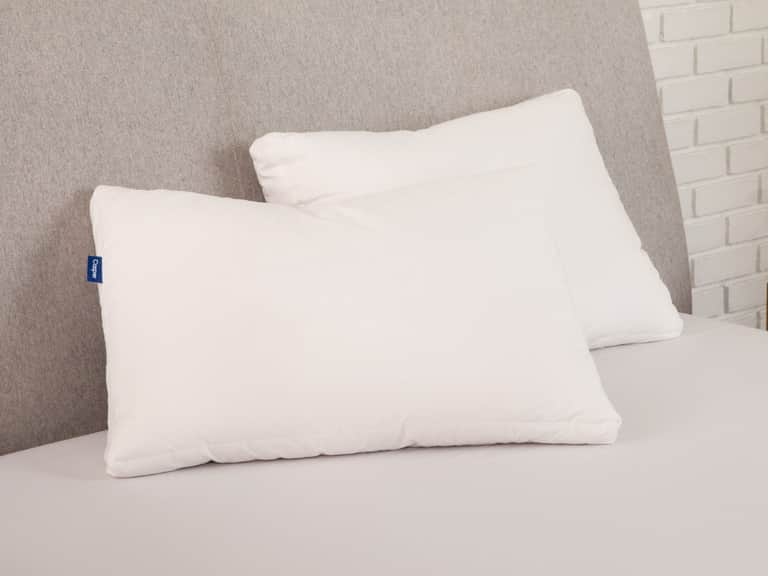
For example, the Down Pillow Double Pack is described as a soft, low-profile option with ethically sourced down and a five-chamber design intended to help it keep its shape. Those details tell you more than a fill-power figure alone would: they describe the stated profile, general feel, fill sourcing, and construction approach. They still cannot tell you exactly how the pillows will feel for your body, so use them as comparison points rather than guarantees.
A practical way to compare down pillows
When two products list different specifications, compare them in a consistent order. Start with the pillow’s stated profile and dimensions. Then check the fill material, the fill-power rating if provided, and whether the manufacturer describes the amount or weight of fill. Next, note the construction, such as chambers or a gusseted edge. Finally, consider the return window, cleaning instructions, and any other terms that determine whether you can assess the pillow at home.
- Begin with your usual position. Think about whether you sleep mainly on your side, back, or stomach, and whether you change positions.
- Look at profile and dimensions. A low-, medium-, or high-loft description gives a starting point, but exact measurements can add useful context.
- Read fill power correctly. Treat it as information about down volume relative to weight, not as a direct height or firmness rating.
- Check the construction. Chambering, gussets, and shell details can influence distribution, shape, and feel.
- Consider care and policy. A pillow’s maintenance requirements and the seller’s trial or return terms may affect your decision.
- Try it in your own bed if possible. Your mattress and normal sleep posture are part of the test.
Comfort is personal—and the mattress is part of it
A pillow does not work in isolation. A soft mattress may allow the shoulder to sink farther for a side sleeper, changing the height needed from a pillow. A firmer surface may create a different gap between head and mattress. These are reasons to judge pillow fit in your actual bed, rather than trying to identify a perfect number in the abstract.
Pay attention to how the pillow feels after you have rested on it for a while. Does it keep enough height for your preferred position? Does the fill shift in a way you like? Do you find yourself folding or bunching it repeatedly? Those everyday responses can tell you more about fit than an impressive-sounding specification.
It is also sensible to separate comfort from health claims. A pillow may feel pleasant and supportive to you, but marketing language or a fill-power rating cannot diagnose or treat neck pain. If discomfort is persistent or concerning, consult a qualified health professional rather than relying on pillow specifications alone.
Care can help preserve the feel
Down pillows need care suited to their materials and construction. Always follow the manufacturer’s instructions, since cleaning methods can vary. Some pillows may be washable; others may require professional care. Using a washable pillow protector can help reduce everyday soil and may mean the pillow itself needs less frequent cleaning.
After use, a down pillow may benefit from gentle fluffing to redistribute the fill and restore some of its loft. This does not change its fill-power rating, but it can help the pillow look and feel more even. If the pillow develops persistent clumping, an unusual odor, or a loss of shape that does not improve with care, consult the product guidance before attempting a more intensive cleaning method.
Responsible sourcing is another consideration for some shoppers. Product descriptions may identify sourcing standards or use terms such as ethically sourced. Read the specific information provided by the maker and look for clear documentation if certification is important to you; broad wording and a numerical loft specification answer different questions.
Common assumptions worth setting aside
- “Higher fill power means a higher pillow.” Not necessarily. Fill power describes the volume potential of a given weight of down; fill quantity and design help determine the finished pillow’s profile.
- “A lofty pillow is automatically supportive.” Height does not tell you how much a pillow compresses or how it feels under your head.
- “The biggest number must be the best choice.” The best fit depends on your preferences, sleep position, mattress, and the construction of the pillow.
- “One profile works for every position.” Sleep posture and body proportions vary. A pillow that feels right for one person—or one position—may not feel right for another.
The bottom line on pillow loft and fill power
Loft and fill power are useful terms once you separate their meanings. Loft describes height; fill power describes how much volume a given weight of down occupies under testing conditions. Neither number, on its own, tells you the precise feel, firmness, or support of a finished pillow.
For a more confident choice, combine the numbers with the pillow’s profile, fill quantity where available, chamber design, shell, and care requirements. Then bring the decision back to the person who will sleep on it: your usual position, your mattress, and whether you prefer a pillow that is soft and moldable or more stable in shape.
The best specification is not necessarily the highest one. It is the set of details that helps you understand what you are buying—and gives you a reasonable chance of finding a pillow that feels comfortable night after night.
Frequently asked questions
Does higher fill power mean a down pillow is better?
No. Higher fill power indicates that a given weight of down occupies more volume. Whether that is preferable depends on the pillow’s overall design, its fill quantity, your desired profile, and how you sleep.
Can fill power tell me whether a pillow is firm?
Not reliably. Firmness and feel depend on several factors, including fill amount, construction, and how much the pillow compresses. Look for a separate firmness description and treat it as a general guide.
Is a low-loft down pillow always right for stomach sleepers?
Low loft may appeal to many stomach sleepers, but personal comfort and body proportions vary. Consider how the pillow feels in your usual position, and do not assume a profile label guarantees a particular fit.
Why can two pillows with similar fill power feel different?
They may use different amounts of down, shell fabrics, dimensions, chamber layouts, or construction methods. The way each pillow compresses and distributes its fill can change the experience even when a specification is similar.